







We build precision playbooks that align your product to what matters most for your highest-value accounts.
We turn big-picture ABM strategy into smart, orchestrated outreach that gets buying groups to move.
We surface the signals that drive action, from intent and engagement to revenue team readiness.
If mass marketing and one-size-fits-all messaging are falling flat with high-value accounts, stay with us.
ARISE GTM is the ABM partner for CMOs, CROs, and Sales leaders ready to:
Target accounts that matter and resonate from day one: No more recycled pitch decks. We craft campaigns that cut through noise and land with relevance across every stakeholder.
Align sales and marketing around real revenue: We helped DirectSourcing unify outreach across multiple buying groups, shortening sales cycles and increasing account-activation rates by double digits.
Turn buying signals into real-world action: Intent data, CRM touchpoints, and content engagement feed one central intelligence hub. Know who’s ready, what they care about, and when to strike.
Warning: side effects include higher ACV, fewer ghosted deals, and sales teams that stop winging it.
Orchestrate multi-threaded campaigns that scale trust: From exec sponsors to end users, we help you create tailored experiences that move accounts from cold to closed, or known to expanded.
Put your brand where buyers are looking: Precision content, personalised ads, and outbound that earns the right to a conversation, not another ignored email.
Measure what moves revenue:
We track engagement, account coverage, and influence, not vanity clicks. Just impact your boardroom will care about.
Ready to build an ABM engine that your revenue team (and CFO) will brag about? Let’s get to work.
Are you looking to close, retain, or upsell enterprise or key target accounts? Let's talk about how you can enable your strategy and execution of account-based marketing programs.
In a focused ABM workshop, we work with your team to identify your goals and objectives. From early-stage account targeting to a comprehensive ABM strategy, we build trust and rapport while providing solid future insights.
Through a focused ARISE OS sprint, we uncover the data gaps, messaging misfires, and GTM misalignments blocking your ABM performance, then build a tailored account-based strategy designed to break into key accounts and scale pipeline.
You leave this stage with an executed, sprint-based ABM strategy, fully operationalised across your HubSpot-based tech stack, with aligned teams, clear ownership, and no wasted motion.
Your ABM revenue engine powers up. Sales, marketing, and RevOps aligned. Real-time account insights. Automated plays. One command centre for predictable, scalable growth, backed by business intelligence that unifies data across 100+ tools to deliver board-level impact and next-step clarity.
It is, bar none, the most effective marketing strategy out there. 91% of companies say using ABM increases their average deal size, and 85% of marketers say ABM outperforms all other marketing investments.
Today’s economic climate demands less waste and more intelligent strategies. With a highly complex B2B buying cycle, the traditional lead handoff from marketing to sales is no longer the efficient or effective option.
ABM gives you: Bigger wins—higher close rates. Better customer satisfaction. Increased LTV. We’ve got the numbers to prove it. Did we mention that it also aligns your marketing and sales teams?
Of companies say using ABM increases their average deal size.
Of marketers report improved win rates with ABM.
The effectiveness of your ABM strategy is measured by its impact on your ROI and business outcomes. We help you drive measurable results, such as:
You can demonstrate to your teams and leadership how ABM contributes to these outcomes through our detailed reporting and analysis.
Understanding the influence of ABM efforts on opportunities is vital for B2B SaaS and fintech companies.
Best practices include using a model or framework that accurately tracks the marketing team's influence on sales opportunities.
This involves leveraging tools and platforms that can provide a clear attribution model, showing how ABM activities contribute to conversions and sales.
Your chosen ABM service should seamlessly integrate with your existing marketing and sales efforts. This includes compatibility with your CRM system, marketing automation tools and sales processes.
Effective integration ensures that ABM efforts complement and enhance your overall marketing strategy rather than operating in a silo.
Our expertise in ABM with HubSpot CRM, predesigned reporting and ability to work with incumbent teams or other external agencies ensures reduced friction and increased productivity.
As your business grows and evolves, your ABM needs may change. Choosing a service that offers scalability and flexibility is important, allowing you or us to adjust your ABM strategy and tactics as needed. This includes the ability to:
You can rest assured that our regular ABM performance updates allow for transparent forecasting and the ability to pivot in a controlled and managed environment.
Our team offers both a done-for-you service and a done-with-you strategic ABM consultancy for teams that prefer a more hands-on approach. We’ll help determine whether a 1:1, 1:Few, 1:Many or a combination is the right approach to help your business grow.
We move fast so you can win fast. But speed doesn’t mean haste. We guarantee to:
For CROs:
Spray-and-pray pipeline, deals stalling at stakeholder sign-off, reps chasing the wrong accounts, low win rates—gone.
For CMOs:
Lead gen black holes, MQLs that sales won’t touch, bloated media spend, siloed campaigns with zero feedback—solved.
Account-Based Marketing flips your GTM from volume to value:
Your team targets real buyers, not just browsers. Sales and marketing move in lockstep. Every campaign is aligned to revenue, not vanity metrics.
ICP & TAM Deep Dive: Zero in on the 5% of your market that’s ready to buy—then ignore the noise.
Message-Market Fit Sprints: Craft hyper-relevant messaging that lands with every stakeholder across the deal team.
Multichannel Activation: Launch orchestrated plays across email, LinkedIn, direct mail, and outbound SDR sequences that hit the mark.
Sales & Marketing Sync: No more “who owns what.” We build shared accountability, shared dashboards, and shared wins.
Campaign Intelligence Layer: Track every touchpoint, surface buyer intent, and pivot in real time to what’s working.
Humphries, H
Leon, J
Brunt, M
Mendiratta, A
Collings, B
De Silva, R
Account-based marketing is a B2B growth strategy that focuses marketing and sales resources on a defined set of high-value target accounts rather than generating broad market demand.
Instead of casting a wide net and hoping the right buyers convert, ABM identifies the specific companies most likely to buy, builds personalised campaigns for the decision-makers and influencers within those accounts, and aligns marketing and sales around shared account goals.
For B2B SaaS and fintech companies with complex, multi-stakeholder buying processes, ABM consistently outperforms traditional demand generation on win rate, deal size, and sales cycle length.
Arise GTM natively implements ABM within HubSpot, connecting account intelligence, campaign execution, and pipeline reporting in a single system.
B2B SaaS and fintech deals involve multiple decision-makers, long evaluation cycles, and buyers who do most of their research before ever speaking to sales.
In this environment, broad demand generation produces a high volume of leads that are the wrong fit, creating waste for marketing and frustration for sales.
ABM solves this by focusing resources on the accounts most likely to buy and building the kind of multi-threaded, personalised engagement that moves buying committees rather than individual contacts.
Companies that align sales and marketing around ABM see up to 60% higher win rates and significantly faster deal cycles. Research from ITSMA shows 87% of marketers running ABM programmes report higher ROI compared to other marketing investments.
HubSpot's ABM functionality spans several Hubs working together.
Marketing Hub provides target account lists, ad audiences, smart content, and multi-touch attribution reporting.
Sales Hub connects account intelligence to deal records and sequences so sales plays trigger from the same account data marketing is using.
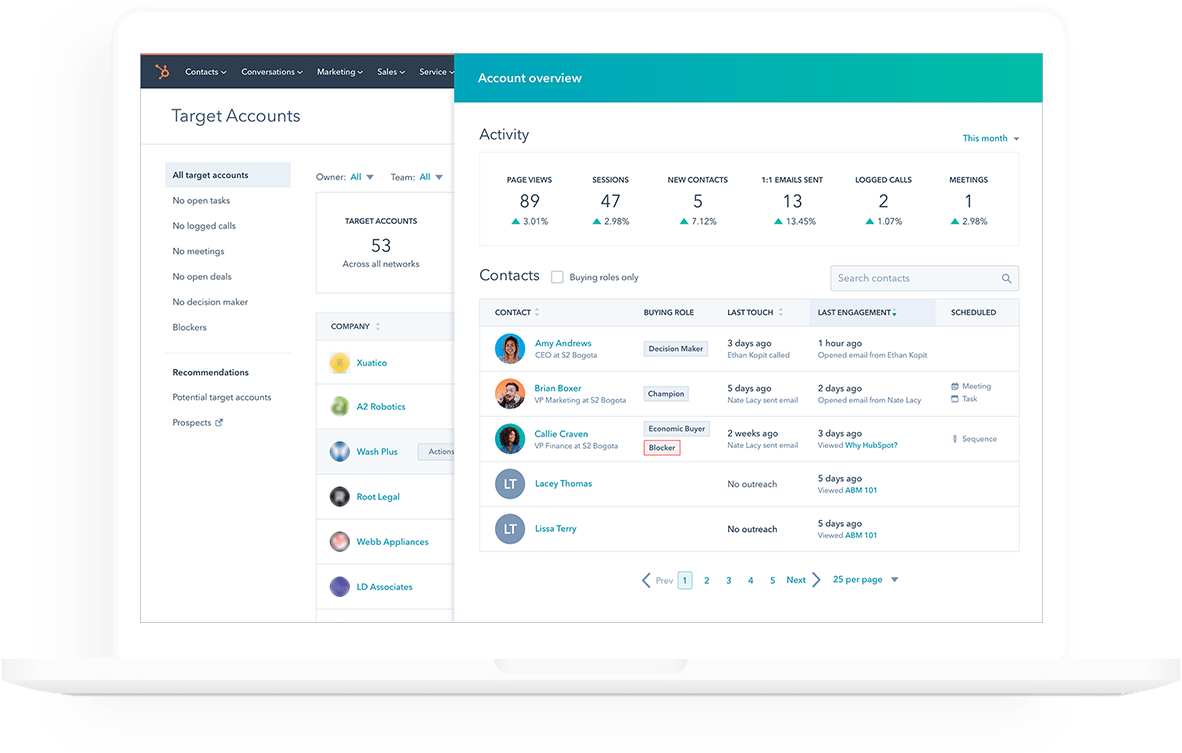
CRM Core houses the company and contact records, buying committee roles, and engagement history that ABM depends on.
Operations Hub adds AI-driven ICP scoring, LinkedIn Sales Navigator sync, and the data quality tools that keep account intelligence reliable at scale.
Service Hub closes the loop by surfacing account health signals and expansion opportunities from existing customers.
Arise GTM audits your current Hub configuration before any ABM build begins to ensure the right tools are in place.
Demand generation focuses on building broad market awareness and capturing inbound interest from anyone who fits a general ICP.
ABM flips this — it starts with a defined list of target accounts and works backwards to build the specific messages, channels, and touchpoints most likely to engage the buying committees within those accounts.
The metrics are different too. Demand generation is measured on lead volume, MQL conversion rate, and cost per lead. ABM is measured on account engagement depth, pipeline influence, deal velocity within target accounts, and win rate against named accounts.
For B2B SaaS and fintech companies with long cycles and high ACVs, ABM produces better outcomes because it concentrates effort where the revenue is most likely to come from rather than optimising for volume.
Companies running structured ABM programmes report consistently strong commercial outcomes.
Research shows 86% of marketers report improved win rates after implementing ABM, and organisations with tight ABM and sales alignment grow revenue up to 208% faster over three years.
At the account level, ABM typically increases average contract value, shortens sales cycles by reducing the number of touchpoints required to move a deal forward, and improves forecast accuracy because pipeline is concentrated in accounts that have been deliberately qualified in.
Arise GTM establishes a revenue baseline before every engagement so results are measured against a clear before and after rather than estimated against industry averages.
The four data inputs that make ABM work are clean firmographic data covering industry, company size, and ARR, buying committee contacts with roles mapped to the decision-making process.
Open opportunity stages in your CRM showing where current deals are in the pipeline, and historical intent signals showing which accounts have already been engaging with your content or category.
Much of this may already exist in your HubSpot CRM. Where gaps exist, particularly around intent data and buying committee mapping, Arise GTM conducts a data audit as part of the ARISE OS sprint before any campaign activity begins, so the programme starts on a foundation that can actually be actioned.
Target account selection at Arise GTM combines HubSpot's AI ICP scoring with first-party fit signals from your CRM, third-party intent data, and direct sales feedback on which account types have historically closed and expanded.
For European-based programmes, Arise GTM primarily uses RollWorks and Nrich for intent data.
For US-focused programmes, Demandbase is the default.
Where clients already have 6sense in place, the programme is built to work with it.
This combination of quantitative scoring and qualitative sales input produces a target account list that both marketing and sales trust, which is the prerequisite for the alignment that makes ABM work.
Engagement rate improvements within target accounts typically appear within 30 to 45 days of campaign activation.
Pipeline impact means that new opportunities are created or existing deals accelerate within target accounts, with follow-up within 60 to 90 days.
Revenue outcomes are visible within one to two quarters as ABM-influenced deals begin to close. Research shows 60% of ABM adopters report at least 10% revenue growth in year one.
Arise GTM stages milestones by phase so expectations are set clearly and results are tracked against the baseline established at the start of the engagement.
These three tiers describe how personalised and resource-intensive the ABM motion is for each group of accounts.
In 1:1 ABM, also called strategic ABM, each target account receives a fully bespoke programme — custom content, personalised outreach, executive relationship development, and dedicated campaign assets. This approach is typically used for your ten to twenty highest-value accounts where the deal size justifies the investment.
In 1:few ABM, accounts are grouped into clusters of five to fifteen based on shared characteristics such as industry, company size, or buying stage, and campaigns are personalised at the cluster level.
In 1:many ABM, personalisation is applied at scale across hundreds of named accounts using intent data and dynamic content. Most mature ABM programmes run all three tiers simultaneously, with the account tier determined by potential contract value and strategic importance.
Arise GTM designs the tier architecture as part of every ABM engagement before any campaign activity begins.
The ARISE® framework applies a five-stage discipline to ABM that turns fragmented campaign activity into a compounding revenue system.
Assess benchmarks your current ICP definition, account data quality, and existing campaign performance to identify exactly where ABM investment will have the most impact.
Research maps buying committee behaviour, intent signals, and the messaging gaps that are preventing accounts from engaging.
Ideate builds the campaign concepts, content angles, and personalisation strategy for each account tier based on real buyer signals rather than assumptions.
Strategise aligns marketing, sales, and RevOps around shared OKRs, account KPIs, and HubSpot workflow architecture.
Execute activates campaigns within 72 hours and iterates weekly based on engagement data.
The result is less wasted spend, warmer accounts entering the sales process, and board-ready attribution dashboards that connect every ABM activity to pipeline and revenue.
The six metrics that define ABM performance are account engagement rate, which measures the percentage of target accounts actively engaging with campaigns, and account coverage, which measures how many contacts within each buying committee have been reached.
Additionally, pipeline influence measures the revenue value of deals where ABM played a role, deal velocity within target accounts compared to non-target accounts, win rate on ABM-influenced opportunities, and average contract value for accounts that went through the ABM programme versus those that did not.
Companies practising structured ABM report 61% stronger marketing and sales alignment and up to 25% faster quota attainment because these metrics are shared across both functions rather than owned by marketing alone.
Companies practising ABM report 61 % stronger marketing and sales alignment and up to 25 % faster quota attainment, thanks to shared dashboards and playbooks.
No. ABM audiences and workflows are built in cloned assets and tested before any changes touch live campaigns.
Rollout is phased during low-traffic windows so existing pipeline activity continues uninterrupted.
In most cases, ABM runs alongside existing demand generation rather than replacing it; the two motions are complementary, with ABM handling high-value named accounts and demand generation continuing to capture broader inbound interest.
HubSpot's native integrations combined with Operations Hub's bidirectional sync push intent signals, engagement data, call notes, and deal stage updates across every platform your revenue team uses.
LinkedIn Sales Navigator syncs buying-committee contact data directly into the HubSpot account records.
Gong call intelligence connects conversation insights to deal context inside the CRM. Salesforce syncs bidirectionally and is the system of record for enterprise clients.
The result is a single source of revenue truth, rather than fragmented account intelligence spread across tools that do not talk to each other.
Arise GTM offers several entry points depending on where you are in your ABM maturity.
The ABM ICP Snapshot is a one-day engagement priced at GBP 750 for companies that want a fast-fit account matrix before committing to a full programme.
ABM entry pilots run from GBP 15,000 to GBP 30,000. Mid-market programmes start at GBP 50,000. Enterprise multi-region rollouts start at GBP 100,000 and above.
All retainer engagements are preceded by an ARISE OS sprint, priced separately from GBP 9,495 for startups to GBP 28,935 for enterprise, which ensures the programme is built on the right account data and ICP definition before campaign spend begins.
Four signals indicate that ABM will deliver a strong return on investment.
Less than 70% of your revenue is coming from your ideal customer segments, meaning significant pipeline is being wasted on poor-fit accounts.
Customer acquisition cost is rising without a corresponding increase in deal quality.
You are entering a crowded market or launching a new product where differentiation requires targeted, personalised engagement rather than broad reach.
Or your sales cycles are long enough and deal values high enough that the investment in account-level personalisation is justified by the potential contract value.
Any two of these being true means ABM will likely outperform your current go-to-market approach on the metrics that matter most to your board.
An ABM agency designs, builds, and runs account-based marketing programmes on behalf of B2B companies.
This typically covers ICP definition and target account selection, buying committee mapping, personalised campaign creation across email, LinkedIn, paid, and direct channels, sales and marketing alignment workshops, intent data integration, CRM and attribution setup, and ongoing campaign optimisation.
The difference between a good ABM agency and a poor one is whether they connect ABM activity to pipeline and revenue outcomes or just to engagement metrics.
Arise GTM runs ABM programmes natively inside HubSpot, with attribution built in from day one so every campaign touchpoint connects to a deal record and every investment is measurable against real revenue impact.
Three things differentiate Arise GTM from most ABM agencies.
First, every engagement starts with an ARISE OS sprint that audits your account data, ICP definition, and CRM configuration before any campaign spend begins, which means the programme is built on a foundation that can actually be measured rather than assumptions that look good in a proposal.
Second, ABM at Arise GTM is built natively inside HubSpot, which means account intelligence, campaign execution, and pipeline attribution live in one system your sales and marketing teams already use, no middleware, no separate reporting platform, no data reconciliation.
Third, Arise GTM applies the ARISE® go-to-market methodology to every programme, which means ABM is built around how your specific buyers actually behave rather than a generic playbook applied regardless of your market, product, or maturity stage.
No, but intent data significantly improves the precision of account selection and campaign timing.
ABM can be run effectively using first-party data from your HubSpot CRM, contact engagement history, website behaviour, and CRM stage data, without third-party intent platforms.
The limitation is that first-party data only tells you about accounts already in your ecosystem.
Intent data from platforms like Bombora, RollWorks, or 6sense surfaces accounts researching your category that have not yet engaged with you, expanding your addressable universe and allowing you to engage them earlier in their buying process.
Arise GTM designs ABM programmes that work within your current data infrastructure and add intent data as a layer where the ROI justifies it, rather than making it a prerequisite for starting.
Stay tuned for the latest news, content, offers and updates from AriseGTM