The bow tie is the most complete model of the B2B revenue lifecycle. But understanding it and operating it are two different things. ARISE is the methodology that turns the shape into a system — and in 2026, AI is the force that runs it at scale.
The Framework Everyone Draws but Few Actually Run
Walk into almost any GTM strategy conversation and someone will draw a bow tie on the whiteboard. Two triangles meeting at a centre point. The left side acquiring customers, the right side retaining and growing them. Clean, intuitive, compelling.
And then, in most organisations, almost entirely theoretical.
The bow tie describes what a healthy revenue engine looks like. It does not tell you how to build one. It identifies that the close is a midpoint, not a finish line — but it does not tell you how to architect what comes before it or operate what comes after.
That gap between understanding a framework and being able to execute it is where most GTM strategies fall apart. Strategy without a system is just a diagram.
The ARISE GTM Methodology — Assess, Research, Ideate, Strategise, Execute — was built to be that system. And in 2026, with AI embedded across both the methodology and the revenue lifecycle, the gap between teams that understand the bow tie and teams that actually run it has never been wider.
One point of clarity before we go further. The bow tie as a revenue lifecycle concept is a widely used industry framework — it describes the shape of a healthy B2B revenue engine and has informed GTM thinking across hundreds of organisations.
Winning by Design, a RevOps training firm we have written about separately, built their Bowtie Data Model on top of it — a CRM data architecture that reflects the lifecycle in how you structure your reporting. That is a specific technical implementation.
What ARISE activates is the underlying framework itself — the full motion from stranger to evangelist, designed and operated as a system. These are complementary ideas, not competing ones. A data model tells you how to measure the bow tie. ARISE tells you how to run it.
Understanding the Bow Tie
Before mapping methodology to model, it is worth being precise about what the bow tie actually represents.
The left triangle is the acquisition motion. It begins with a stranger — someone who fits your ideal customer profile but has no awareness of your brand — and moves them through awareness, consideration and decision until they become a paying customer. This is the territory most GTM teams know well. Campaigns, sequences, pipeline, close.
The centre point is the moment of conversion. The signed contract, the activated account, the deal marked closed-won. It is the single most celebrated moment in most sales organisations, and the point at which most GTM strategy effectively stops.
The right triangle is the expansion motion. Onboarding, adoption, retention, expansion, advocacy. The customer who signed becomes a customer who succeeds, then a customer who grows, then a customer who tells others. The right side of the bow tie is where the economics of a subscription business are actually made or lost. Net revenue retention, expansion ARR, referral pipeline — these all live here.
The bow tie's central insight is this: the economics of the left side only make sense if the right side performs. A high-CAC acquisition motion funded by churn is a business burning itself down.
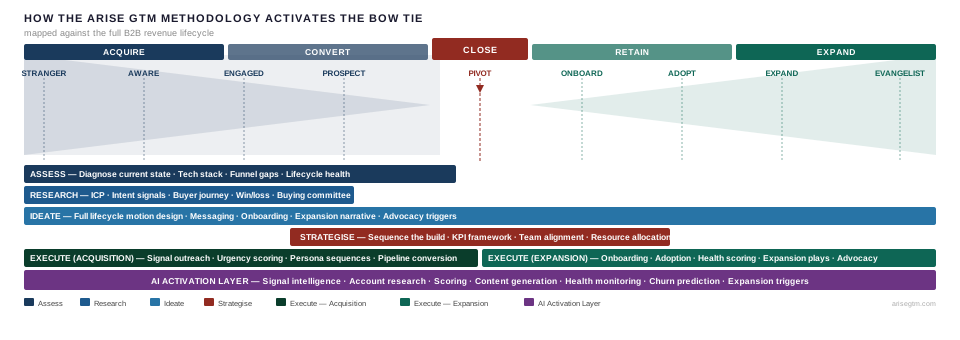
Where ARISE Maps to the Bow Tie
TABLE 1 — ARISE Stages Mapped to the Bow Tie
| ARISE Stage | Bow Tie Zone | Primary Output |
|---|---|---|
| Assess | Pre-lifecycle — full audit | Honest current-state diagnosis across both triangles |
| Research | Left triangle — stranger to awareness | Validated ICP, buyer signals, journey map |
| Ideate | Left and right triangle | Full-lifecycle motion design — acquisition through advocacy |
| Strategise | Centre point | Sequenced build plan, aligned KPIs, team ownership |
| Execute | Left triangle — continuous | Outbound, pipeline, conversion |
| Execute | Right triangle — continuous | Onboarding, adoption, expansion, advocacy |
Assess — Diagnosing the Full Lifecycle
Before you can fix a bow tie that is not working, you need to understand exactly where it is breaking.
Assess is a diagnostic phase. It audits your current state across the entire revenue lifecycle — not just pipeline and conversion, but onboarding friction, adoption gaps, churn drivers, expansion patterns and advocacy triggers. It looks at your tech stack, your data, your team structure and your processes and asks a simple question: does this infrastructure support both sides of the bow tie, or just one?
Most assessments reveal the same pattern. Significant investment in left-side infrastructure — CRM configuration, lead scoring, campaign tooling, sales enablement — and comparatively underdeveloped right-side operations. CS running on spreadsheets. No defined expansion motion. Referral left entirely to chance.
AI accelerates Assess significantly. Pattern recognition across CRM data, funnel conversion analysis, tech stack gap identification and revenue leak detection — tasks that previously required weeks of manual audit — can now be surfaced in hours. The output is faster, more accurate and grounded in actual data rather than team assumptions.
Assess makes the problem visible. You cannot design a system you have not honestly diagnosed.
Research — Mapping the Journey from Stranger to Evangelist
The bow tie is, at its core, a journey. Someone who has never heard of you becomes someone who cannot stop talking about you. Research is the phase that maps what actually drives progression at every stage of that journey.
This is not generic buyer persona work. Research in the ARISE context means understanding the specific signals that move your specific buyers — what triggers initial awareness, what accelerates consideration, what stalls decisions, what creates early adoption, what drives expansion intent and what converts satisfied customers into active advocates.
In 2026, AI transforms Research from a retrospective exercise into a live intelligence function. Intent signals are harvested in real time. ICP firmographic data is scored automatically. Win and loss patterns are identified across hundreds of historical deals in minutes. Buying committee behaviour is mapped before a single outreach call is made.
Research replaces assumption with evidence. AI ensures that evidence is always current.
Ideate — Designing the Full-Lifecycle Motion
With an honest diagnosis and validated research in hand, Ideate is where you design the GTM motion that operates across both triangles.
This is where the bow tie stops being a diagram and starts becoming a blueprint. Ideate produces the positioning and messaging architecture that carries a buyer from first encounter through to close. It designs the onboarding and adoption framework that moves a new customer to value quickly. It builds the expansion narrative — the story that makes growth feel like a natural next step rather than a sales pitch. And it identifies the advocacy trigger points: the moments of success that, if recognised and amplified, turn customers into referral engines.
AI plays a generative role in Ideate. Messaging frameworks, persona-specific positioning, content gap analysis and onboarding journey design can all be modelled, tested and refined at a pace that was simply not possible before. The quality of the Ideate output — and therefore the quality of everything that follows — is materially higher when AI is embedded in the process.
Strategise — Sequencing the Build
A well-designed bow tie is only valuable if it is built in the right order. Strategise is the phase that sequences the work — prioritising initiatives, defining the infrastructure required at each stage, setting the KPIs that will confirm whether each part of the lifecycle is performing, and aligning the team around a shared roadmap.
Critically, Strategise forces resource allocation decisions that most GTM leaders avoid. If the right side of the bow tie is broken, it may need to be fixed before additional investment in the left side makes sense. If onboarding failure is the primary driver of churn, optimising outbound sequences will not solve the underlying problem.
AI enables better Strategise decisions through revenue scenario modelling — surfacing the likely downstream impact of different sequencing choices before a single resource is committed.
Execute — Activating and Operating the Full Lifecycle
Execute is where the bow tie comes alive. It is also where AI delivers its most significant commercial impact.
On the left side, Execute is the outbound and inbound motion. In 2026, AI-powered GTM systems handle the intelligence layer that makes this work at scale — account research, intent scoring, urgency classification, persona-specific outreach generation and sequence automation. What previously required a skilled SDR spending 35 to 45 minutes researching a single account can now be completed in under 90 seconds, with greater accuracy and full personalisation across the buying committee.
On the right side, Execute is the post-sale operating system. AI monitors customer health scores continuously, predicts churn risk before it becomes visible to the human team, identifies expansion trigger moments from product usage signals, automates onboarding sequences and generates advocacy prompts at the moments of peak customer satisfaction.
Execute is the phase that never ends. Unlike the earlier stages of ARISE, which have defined outputs and completion points, Execute is continuous. It runs, measures, learns and iterates. AI does not replace the human judgment required to run an Execute motion well — but it removes the manual overhead that previously made operating both sides of the bow tie simultaneously almost impossible for a lean GTM team.
AI Activation Across the Full Bow Tie
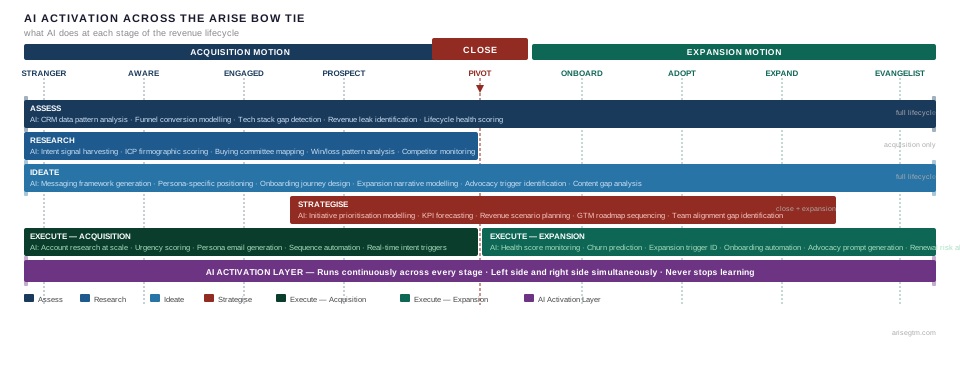
The table below maps what AI specifically does at each intersection of ARISE and the bow tie.
TABLE 2 — AI Activation by Stage and Bow Tie Zone
| ARISE Stage | Bow Tie Zone | AI Activation |
|---|---|---|
| Assess | Full lifecycle | CRM pattern analysis, funnel conversion modelling, tech stack gap detection, revenue leak identification |
| Research | Left triangle | Intent signal harvesting, ICP scoring, buying committee mapping, win/loss pattern analysis |
| Ideate | Left and right triangle | Messaging generation, persona positioning, onboarding journey design, expansion narrative modelling |
| Strategise | Centre point | Initiative prioritisation, KPI forecasting, revenue scenario planning, roadmap sequencing |
| Execute — left | Acquisition motion | Account research, urgency scoring, persona email generation, sequence automation |
| Execute — right | Expansion motion | Health score monitoring, churn prediction, expansion trigger identification, advocacy prompt generation |
The Stranger-to-Evangelist Arc
Read the bow tie from left to right through the lens of ARISE and what you see is a story — one that, in 2026, AI helps engineer at a speed and scale that changes what is possible for a B2B GTM team.
A stranger — someone who fits your ICP but has no awareness of your brand — is identified through AI-powered Research and reached through an AI-activated Execute motion. Signal-led, persona-specific outreach creates awareness. Strong positioning and messaging, built in Ideate, moves them through consideration. A well-run sales motion closes the deal.
Now the story continues.
Structured onboarding, designed in Ideate and operationalised by Execute, moves the customer to first value quickly. AI monitors adoption signals and flags health risks before they become churn conversations. At the right moment — identified by AI from product usage data and triggered automatically — an expansion conversation happens. It lands well because it is grounded in actual behaviour, not a calendar reminder.
Time passes. The customer succeeds. At the moment of peak satisfaction — again, identified and timed by the system, not left to chance — they are invited into an advocacy motion.
The stranger has become an evangelist.
This is not a lucky outcome. It is an engineered one. ARISE provided the methodology. The bow tie provided the model. AI provided the activation layer that makes it run at scale.
Why Most Bow Ties Break at the Centre Point
If the bow tie is so well understood, why do so many organisations fail to run it effectively?
The answer, almost always, is the handoff.
The centre point — the moment of close — is where the acquisition team's job ends and the customer success team's job begins. In organisations where these functions are misaligned, this handoff is a fracture point. Information is lost. Context is not transferred. The customer who was carefully nurtured through a six-month sales process arrives on day one to an onboarding experience that feels like starting from scratch.
AI does not automatically fix this. But when an AI-activated GTM system is running correctly, it means that everything learned about a buyer during the acquisition motion — their priorities, their concerns, their buying committee dynamics, their urgency triggers — is available to the CS team from day one. The intelligence does not stop at the centre point. It carries through.
ARISE prevents the fracture by treating the bow tie as a single system from the outset. AI ensures the intelligence that powers that system is continuous rather than siloed by team boundaries.
The Metrics That Matter Across the Bow Tie
TABLE 3 — Bow Tie Metrics by Side
| Metric Type | Metric | What It Confirms |
|---|---|---|
| Left side | Qualified pipeline generated | Acquisition motion is producing the right opportunities |
| Left side | Stage conversion rate | Buyers are progressing through the funnel |
| Left side | Average deal velocity | No unnecessary friction stalling closes |
| Left side | Win rate by segment | ICP targeting is accurate |
| Left side | CAC by channel | Acquisition investment is appropriately allocated |
| Right side | Time-to-first-value | Onboarding is moving customers to outcomes quickly |
| Right side | Product adoption rate | Customers are embedding the product in their workflow |
| Right side | Net revenue retention | Expansion is outpacing churn |
| Right side | Expansion ARR | Upsell and cross-sell motion is active |
| Right side | Referral pipeline % | Advocacy is generating commercial return |
| Connective | CAC payback period | Left-side investment is justified by right-side performance |
| Connective | LTV by cohort | Revenue per customer is growing over time |
| Connective | Expansion to new logo ratio | Growth is increasingly efficient |
When ARISE is operating correctly and AI is activated across the lifecycle, both sides of the bow tie show improving metrics over time. The connective metrics reflect a business becoming more efficient as it scales — which is the definition of a revenue engine that is genuinely working.
Building Your Bow Tie with ARISE in 2026
The bow tie is the right model. The ARISE GTM Methodology is the system that builds and runs it. And AI is the activation layer that makes operating both sides simultaneously achievable for a GTM team of any size.
In 2026, the competitive gap between teams running an AI-activated, methodology-driven revenue lifecycle and teams still managing a left-side-only funnel is significant and growing. The technology to close that gap is available. The methodology to apply it systematically is documented.
The question is no longer whether to run a bow tie. It is whether you are building the system to operate it properly.
Assess what you have. Research what drives your buyers and customers. Ideate the full-lifecycle motion. Strategise the build. Execute — with AI — relentlessly.
That is how the bow tie moves from diagram to revenue engine.
Frequently Asked Questions
What is the bow tie framework in GTM?
The bow tie framework represents the full B2B revenue lifecycle as two triangles meeting at a centre point. The left triangle covers the acquisition motion from stranger to customer. The centre point is the moment of conversion. The right triangle covers the expansion motion from customer to evangelist. The central insight is that the deal close is a midpoint, not a finish line, and that sustainable revenue requires operating both sides of the lifecycle.
What is the ARISE GTM Methodology?
ARISE is a five-stage go-to-market methodology created by Paul Sullivan and published in Go-To-Market Uncovered (Wiley, 2025). The five stages are Assess, Research, Ideate, Strategise and Execute. It provides the systematic process for building and operating a full revenue lifecycle across the bow tie — from ICP definition and outbound acquisition through to onboarding, expansion and advocacy.
How does AI activate the ARISE methodology?
AI activates ARISE at every stage. In Assess, it accelerates diagnostic analysis of CRM data and funnel performance. In Research, it harvests live intent signals and scores ICP fit at scale. In Ideate, it generates messaging frameworks and onboarding designs. In Strategise, it models revenue scenarios and prioritises initiatives. In Execute, it automates account intelligence, outreach personalisation, health monitoring, churn prediction and expansion trigger identification across both sides of the bow tie.
Why do most companies fail to operate the right side of the bow tie?
The centre point acts as an organisational boundary rather than a relay. The acquisition team's investment in the buyer stops at close and customer success operates reactively rather than through a designed system. ARISE prevents this by treating the bow tie as a single system. AI-activated GTM means the intelligence gathered during acquisition carries directly into the post-sale motion rather than being lost at the handoff.
What metrics should you track across the bow tie?
Left-side metrics include pipeline generated, stage conversion rates, deal velocity, win rate and CAC by channel. Right-side metrics include time-to-first-value, adoption rates, net revenue retention, expansion ARR and referral pipeline percentage. Connective metrics — CAC payback period, LTV by cohort and expansion to new logo ratio — measure the efficiency of the full lifecycle.
Paul Sullivan is the creator of the ARISE Go-To-Market Methodology and author of Go-To-Market Uncovered (Wiley, 2025). ARISE GTM works with B2B SaaS and fintech companies to build AI-activated revenue engines that operate across the full customer lifecycle.
Book a GTM Strategy Consultation — arisegtm.com/contact
Explore the ARISE Methodology — arisegtm.com/the-arise-methodology
%20small.jpg)