Walk into any 2026 planning session and count the frameworks already in the building. There is a sales qualification model on the deal record. There is a lifecycle diagram on the whiteboard. There is an operating system somebody picked up at a roadshow.
Each one was adopted to fix a specific problem, and each one works inside its own lane. The trouble is that none of them was designed to talk to the others, and so the organisation ends up running five partial systems that quietly contradict each other.
TL;DR
2026 is the year GTM stops being a stack of methodologies and starts being a system. This guide compares the frameworks every revenue leader is weighing right now, the Bow Tie, MEDDICC, SPICED and GTM Partners' GTM Operating System, and shows why ARISE is the only one built as governance that iterates the flywheel every single run. Read on if you want consistency, not another playbook.
The methodology pile-up nobody planned for
This is the real cost of the methodology pile-up. It is not that any single framework is wrong. It is that a business cannot be governed by a committee of frameworks that each see only one slice of the revenue engine. Sales optimises qualification, marketing optimises pipeline, customer success optimises retention, and leadership optimises the slide. Everyone is busy, and confidence is still low, which is the exact pattern we see when we first open a new client's HubSpot instance.
What has changed since 2024 is not the number of frameworks available. It is what good actually requires. The market moved faster than the playbooks, funding got harder, and boards started scrutinising every pound spent on growth. In that environment, the winning question is no longer "what is our sales methodology" but "how fast can we learn and redeploy that learning across the whole engine".
As Paul Sullivan, founder of Arise GTM, puts it: "The biggest shift is that GTM is no longer a sequence of functions. It's a system. In 2024, most companies were still thinking in terms of campaigns, channels, sales motions, enablement programs and RevOps projects. They were optimising components. In 2026, the winners are optimising feedback loops. The methodology isn't the asset. The learning cycle is."
That single reframe is what separates a methodology you adopt from a system you govern. The rest of this guide shows where each popular framework sits, where it stops, and why the ARISE methodology was built to close the loop the others leave open.
What makes a great GTM methodology in 2026
A great GTM methodology in 2026 is judged on one thing above all others: how quickly it turns evidence into a better decision, and then turns that decision into the next round of evidence. Speed of execution still matters, but speed of learning matters more, because execution without learning just gets you to the wrong destination faster.
That standard reshapes the evaluation criteria entirely. A framework is no longer great because it standardises behaviour. It is great because it improves the quality of decisions across functions and keeps improving them.
Standardised behaviour is table stakes. Anyone can teach a sales team to fill in a qualification card. The harder, rarer thing is a model that tells the whole organisation when to change course and why.
This is where the divide between the two kinds of teams becomes obvious.
Sullivan frames it cleanly: "Governed teams have decision-making frameworks. Sales-play teams have activity frameworks. The difference is massive. Sales-play organisations obsess over sequences, objection handling, pipeline stages, qualification frameworks and SDR productivity. Governed GTM organisations obsess over signal collection, market learning, strategic alignment, decision rights and feedback loops.
The best teams I've worked with can explain why they chose a market, why they prioritised a segment, why they changed positioning, why they launched a campaign, and what evidence triggered the decision. Most teams can only explain what they're doing. Governed teams can explain why."
So, a great methodology in 2026 has to do four things that the previous generation never had to.
-
It has to collect signal continuously, not at quarterly review.
-
It has to give the organisation a way to decide what that signal means, because a flood of data with no decision rights is just noise.
-
It has to align functions around the same evidence rather than the same vocabulary, since shared language without shared truth produces confident, coordinated mistakes.
-
And it has to feed every outcome back into the next cycle, so that the system compounds rather than resets.
The third of those is the one teams underestimate most. It is entirely possible for sales, marketing and customer success to use identical words, ideal customer profile, qualified, retention-ready, and still mean three different things by each of them. When that happens, alignment is a fiction. The teams nod in the same meetings and then act on conflicting definitions, which is worse than open disagreement because nobody notices it is happening.
Real alignment is not a shared glossary. It is a shared source of truth, the same data, in the same system, defining the same terms the same way for everyone who touches the revenue engine. That is a much higher bar, and it is one that lives or dies on where your evidence is stored and how it is governed.
Hold the rest of this comparison against those four tests, and the gaps appear quickly. Most of the popular frameworks were engineered to do one of the four brilliantly, and were never asked to do the other three.
The frameworks, and where each one stops
Each of the dominant frameworks earns its reputation. The problem is never quality. It is the scope. Comparing them across five consistent lenses, organisational reach, what they govern, evidence handling, iteration, and the layer they operate at, shows precisely where each one hands off and leaves a gap.
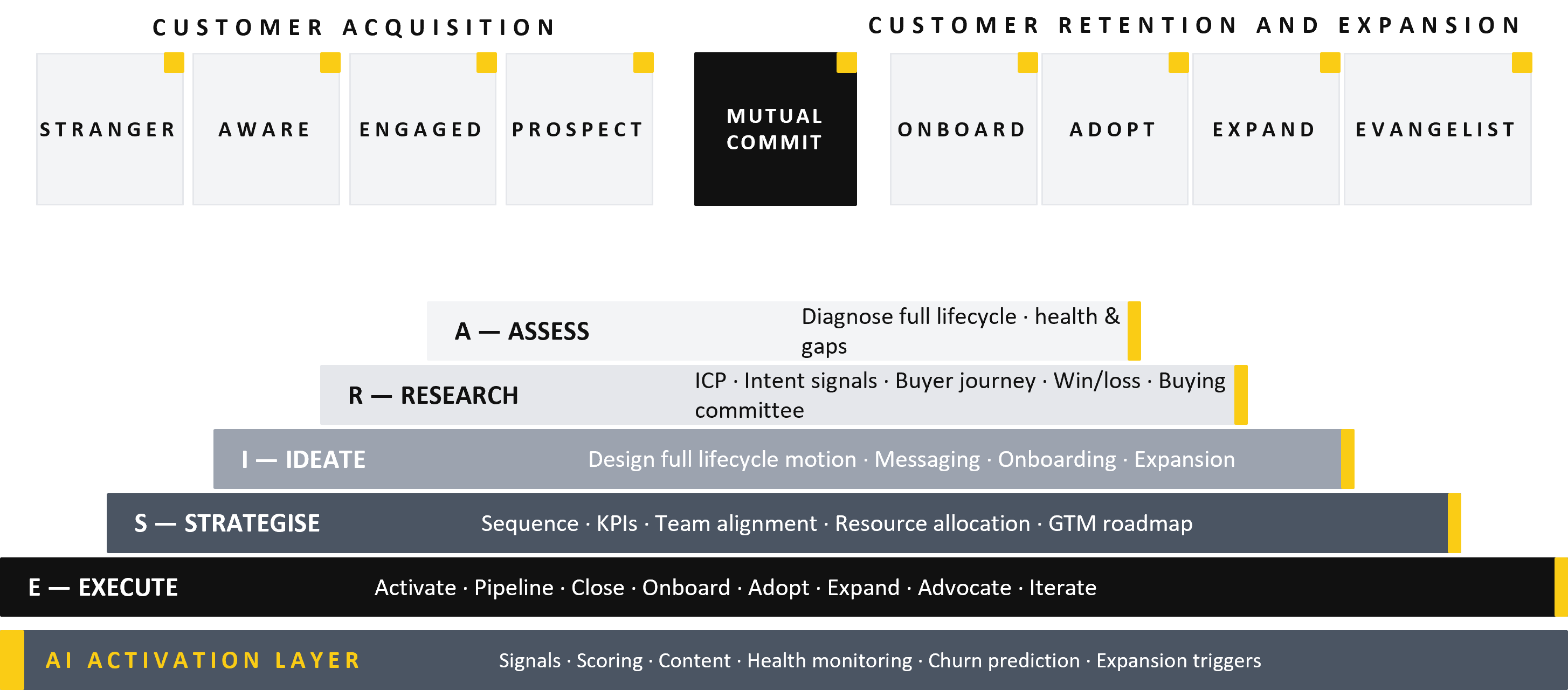
The Bow Tie is the most complete picture of the B2B revenue lifecycle, popularised by Winning by Design as the shape of a healthy revenue engine from stranger to evangelist. Its great contribution is reframing the close as a midpoint rather than a finish line, which forces retention and expansion into the same conversation as acquisition.
Its limit is that it describes the shape without telling you how to build or operate it. The Bow Tie is a map, not a motion, which is exactly why we wrote a separate piece on how ARISE activates the Bow Tie framework rather than treating the diagram as a strategy in itself.
MEDDIC and its extensions, MEDDICC and MEDDPICC, are the gold standard for enterprise deal qualification, born at PTC and refined across thousands of complex sales cycles. They give a revenue team a rigorous, repeatable way to qualify economic buyers, decision criteria, decision processes and champions.
That rigour is real, and we build it directly into client deal records. But qualification is a downstream discipline. MEDDICC tells you whether a deal is real. It says nothing about whether you chose the right market, built the right positioning, or priced to value in the first place.
SPICED, also from the Winning by Design school, is a customer-centric framework spanning Situation, Pain, Impact, Critical Event and Decision. It is sharper than older models because it anchors on the buyer's problem rather than the seller's checklist, and it threads neatly through the lifecycle.
We compared it in depth in our Winning by Design analysis. Yet SPICED, like MEDDICC, lives inside the revenue team. It governs conversations, not the organisation. It is sales-led by design, and proud of it.
That is the through-line for this first group. The Bow Tie, MEDDICC and SPICED are all, in different ways, sales and revenue-team frameworks. They are excellent at governing how a revenue function qualifies, sequences and progresses. They were never built to align product, pricing, marketing and leadership around a single source of evidence, and they do not pretend to.
GTM Partners' GTM Operating System is a different animal, and a more interesting comparison. Built by Sangram Vajre and Bryan Brown on the back of their bestselling MOVE framework, Market fit, Operations, Velocity and Expansion, the GTM Operating System deliberately moves the conversation beyond sales and marketing silos toward whole-org orchestration.
It is structured as an eight-pillar model, with each pillar corresponding to a strategic question, designed so that a leadership team can express its GTM strategy on a single slide. This is a genuinely valuable step forward, and it shares real DNA with ARISE.
Sullivan is direct about the overlap and the divergence: "I think GTM Partners has done a strong job helping the market recognise that GTM needs an operational structure. The GTM OS concept moves the conversation beyond traditional sales and marketing silos and pushes organisations toward orchestration. That's a positive shift.
Where I see alignment with ARISE is the belief that GTM should be cross-functional, that revenue teams need common operating principles, that execution should be driven by evidence, and that continuous improvement matters.
Where ARISE goes further is in governance and iteration. Most GTM operating systems focus heavily on orchestration. ARISE focuses on orchestration and adaptation. The flywheel is the product. Not the process documentation. Not the operating model. The learning engine itself."
There is a neat coincidence worth naming. Both ARISE and the GTM Operating System land on eight pillars, but they mean very different things by them.
GTM Partners' pillars are strategic questions you answer to articulate a plan. The eight pillars of ARISE, Discovery, Personas and Jobs to Be Done, Positioning and Value Proposition, Pricing, Sales Enablement, Marketing Tactics, Onboarding and Retention, and Product Development, are operational domains you build, instrument and run inside your CRM.
One framework helps you decide what your strategy is. The other governs how that strategy gets executed, measured and revised. That is why we treat the two as complementary rather than competitive. GTM Partners frames the questions beautifully. ARISE answers them in your HubSpot instance, then asks them again next quarter with fresh evidence.
Which brings us to where ARISE sits on all five lenses.
-
On organisational reach, it spans the entire revenue engine, not just the sales team.
-
On what it governs, it governs decisions, not activities.
-
On evidence, it makes the learning loop the central artefact.
-
On iteration, it re-runs by design.
-
And on the layer it operates at, it is governance, the thing that decides when and how every other framework on this list should be applied.
That last point is the one most people miss, so it deserves its own section.
How to choose, and where the money leaks
The honest answer to "which framework should we adopt" is "most of them, but in the right order and under the right governance". The frameworks above are not mutually exclusive. The failure mode is not picking the wrong one. It is picking a downstream one and treating it as a transformation.
Map it by where your organisation actually is. Pre-Series A, the work is clarity: who you serve, what you stand for, and why anyone should care. A qualification framework here is premature because you have nothing reliable to qualify against yet. This is Assess and Research territory, the front of the ARISE framework, and skipping it is the single most expensive shortcut in GTM.
Series A to B, the work shifts to demand generation plus the RevOps spine that makes growth repeatable. Here, MEDDICC and SPICED start to earn their keep, because you now have enough deal volume and enough market evidence for qualification rigour to pay off.
The Bow Tie becomes a useful operating lens for designing the handoffs between acquisition and retention. But all of it sits on top of an aligned strategy, not in place of one.
Series C and beyond, the work is category leadership, account-based motions and the kind of cross-functional governance that keeps a large revenue organisation coherent.
This is where an operating-system mindset, whether GTM Partners' or ARISE, becomes essential, because the cost of misalignment scales with headcount.
The leak happens when teams invert that order. Sullivan has watched it repeatedly:
"They mistake qualification for strategy. I've seen companies spend six figures on enablement, consultants, certifications and tooling only to discover the wrong ICP, weak positioning, poor segmentation, broken handoffs, misaligned incentives and low market demand.
MEDDICC doesn't fix bad strategy. SPICED doesn't fix poor market selection.
No qualification framework can compensate for a GTM system that is learning the wrong lessons. The biggest waste is treating sales methodology as a transformation initiative when it's actually a downstream optimisation.
If your Assess and Research phases are weak, you're simply helping sales teams qualify bad opportunities more efficiently."
Read that last line twice, because it is the whole argument in miniature. A brilliant qualification framework applied to a broken strategy does not save you money. It accelerates the rate at which you spend money pursuing the wrong customers. The frameworks are not the risk. The absence of governance over them is.
Picture the pattern in the abstract, because we see a version of it most quarters.
A fifty-person B2B SaaS business closes a Series B, and the board wants predictable growth. The fix everyone reaches for is a sales methodology rollout:
-
certify the reps in MEDDPICC,
-
buy the enablement platform,
-
hire a consultant to drill the team.
Six months and a six-figure spend later, win rates have barely moved.
When you actually open the engine and run an Assess, the real problem is upstream. The ICP was never validated, so half the pipeline was wrong-fit from the start. Two segments were being sold the same generic positioning. The handoff from sales to onboarding lost context every single time, so the customers who did close churned within a year.
None of that is a qualification problem.
MEDDPICC did its job perfectly; it just qualified opportunities inside a market the company had never properly chosen. Run the same situation through a governed loop, and the order reverses.
Assess and Research surface the ICP and positioning gaps before a penny goes on enablement. Strategise fixes the segmentation and the handoff. Only then does the qualification framework get pointed at a market worth qualifying, and now the same MEDDPICC investment compounds instead of leaking. Same tools, same team, opposite outcome. The variable was governance, not the framework.
Inside the ARISE methodology
ARISE is five phases: Assess, Research, Ideate, Strategise and Execute, and the order matters because each phase feeds the next.
Assess takes stock of reality by reviewing revenue performance, conversion signals and customer outcomes.
Research gathers the evidence through customer interviews, market shifts and competitor movements, using established tools like SWOT and Porter's Five Forces rather than gut feel.
Ideate generates and tests hypotheses for new motions and opportunities. Strategise prioritises the initiatives, allocates the resources and defines the success metrics.
Execute deploys the programmes, measures the outcomes and captures the learning.
If that were the whole story, ARISE would be one more linear methodology. It is not, and the difference is the single most important thing to understand about it.
The outputs of Execute become the inputs of the next Assess. The cycle does not end at execution. It loops, and it loops every time, by design.
This is why Sullivan insists on calling ARISE a governance approach rather than a methodology:
"Because methodologies tell people what to do. Governance determines how decisions get made. That's a fundamentally different objective. ARISE isn't trying to replace MEDDICC, SPICED, Challenger, ABM, PLG or Customer Success frameworks.
It governs how and when those approaches should be applied. Then the outputs immediately become inputs for the next Assess phase. Every campaign, every quarter, every product launch, every market expansion. The organisation becomes a learning system rather than a planning system."
That distinction, learning system versus planning system, is the crux of the reliability claim.
A planning system produces a strategy, and a strategy decays the moment the market moves.
A learning system produces a strategy and then a mechanism for knowing when that strategy is wrong, which is the only thing that stays reliable as conditions change.
This is also why Arise has always favoured the flywheel over the funnel. A funnel ends at the sale. A flywheel keeps turning, with retention and expansion feeding acquisition, and every revolution making the next one easier.
In practice, this is operationalised on a single platform. ARISE runs inside HubSpot as the system of record, so that the signal collected in Assess, the evidence gathered in Research and the outcomes measured in Execute all live in one place rather than scattered across tools. That is what lets the loop actually close.
When the eight operational pillars are instrumented in the same CRM, a change in onboarding shows up in retention data, which shows up in the next Assess, which informs the next round of positioning. The system teaches itself.
We go deeper on this operating model in our B2B SaaS GTM playbook, but the principle is simple. Strategy, technology and repeatable execution are not three separate workstreams in ARISE. They are one governed loop.
The 2026 forecast: why governance beats tooling
The next eighteen months will reward governance and punish accumulation. Here is what we are watching, and the signals are already pointing the way.
First, AI will widen the gap between learning organisations and accumulating ones. The teams buying the most AI tools will not win. The teams with the fastest learning loops will. We are already seeing pilots stall not because the models are weak but because nobody decided which insight mattered, which is a governance failure wearing a technology costume.
Second, the bottleneck shifts from generating insight to deciding on it. Sullivan is blunt about this:
"Most people assume AI creates a tooling challenge. I think it creates a decision-making challenge. The bottleneck is no longer generating insight. The bottleneck is deciding which insight matters. AI can now analyse markets, research competitors, score accounts, generate content, identify intent, build forecasts and surface risks.
What it can't reliably do is determine organisational priorities. That's still a governance problem. Agentic systems dramatically increase the volume of signals entering the business. Without governance, that creates noise. With ARISE, those signals become fuel. AI accelerates the flywheel. Governance determines whether the flywheel creates momentum or chaos."
Third, agentic GTM moves from novelty to operating model. As agents take on more of the research, scoring and drafting, the human role concentrates on diagnosis and decision rights, which is precisely the AI-native, human-first principle we build on.
Our work on the agentic GTM operating model maps how this plays out across RevOps, BI and lifecycle, and the common thread is that governance, not headcount, becomes the constraint.
Fourth, the one-time GTM plan dies for good. Annual planning cycles cannot keep pace with quarterly, sometimes monthly, market shifts. The organisations that thrive will be the ones whose strategy updates continuously because their methodology was built to iterate, which is the entire reason we keep the loop at the centre of how we work with AI in our AI-native GTM guide.
The pattern across all four is the same. The constraint in 2026 is not access to frameworks, data or AI. It is whether you have a governed way to decide what to do with them. That is the gap ARISE was built to fill.
Rise, don't react
The frameworks on this list are not the enemy. They are the instruments. ARISE is the conductor, the governance layer that decides which instrument plays, and when, and then listens to the result and adjusts for the next bar. That is what makes it consistent and reliable while the market keeps changing underneath everyone.
If your GTM is a pile of partial systems that each see one slice of the engine, it is time to govern them as one. Let's build a learning system, not another plan.
You can do one of three things next. Book a GTM audit, and we will show you exactly where your revenue engine leaks and which framework belongs at which layer. Schedule a strategy session to map your own ARISE loop. Or run the diagnostic-first Assess engagement that every Arise programme begins with, so your first move is evidence, not assumption.
FAQs
What is the difference between a GTM methodology and a GTM operating system?
A GTM methodology is a defined approach to a GTM task, qualification, lifecycle mapping, positioning. A GTM operating system is broader, organising multiple functions around shared principles.
ARISE is broader still: it is a governance layer that decides how and when each methodology and operating principle is applied, then iterates based on outcomes.
In short, a methodology tells you what to do, an operating system tells you how to organise it, and governance decides what is worth doing next. See the section on why ARISE is a governance approach for the full distinction.
Is the ARISE methodology better than MEDDICC or SPICED?
It is not a like-for-like comparison, which is the point. MEDDICC and SPICED are sales qualification frameworks that govern how a revenue team works a deal. ARISE governs the whole organisation, including when MEDDICC or SPICED should be used.
We build MEDDIC and MEDDPICC directly into client deal records, so ARISE and those frameworks run together. ARISE sits above them as the governing loop, not beside them as a rival.
How does ARISE compare to GTM Partners' GTM Operating System?
They share real DNA: both are cross-functional, evidence-driven and committed to continuous improvement, and both happen to use eight pillars.
The difference is that GTM Partners' model excels at orchestration and framing strategy on a slide, while ARISE adds governance and iteration, operationalising the strategy inside your CRM and re-running the loop every cycle.
We see them as complementary. GTM Partners frames the questions; ARISE answers and re-asks them with fresh evidence.
What are the five stages of ARISE?
Assess, Research, Ideate, Strategise and Execute.
Assess takes stock of current performance and signals. Research gathers market and customer evidence. Ideate generates and tests hypotheses. Strategise prioritises and resources the plan. Execute deploys, measures and captures learning.
The defining feature is that Execute's outputs become the next Assess's inputs, so the cycle iterates continuously rather than ending. More detail is in the inside-ARISE section above.
Why does Arise call ARISE a governance approach rather than a methodology?
Because methodologies prescribe what to do, while governance determines how decisions get made. ARISE does not replace MEDDICC, SPICED, Challenger, ABM or PLG. It governs how and when each is applied, and feeds every outcome back into the next decision cycle.
That shift turns an organisation from a planning system into a learning system, which is what keeps performance reliable as the market changes.
Does ARISE work with our existing sales methodology?
Yes, and that is by design. ARISE is methodology-agnostic at the execution layer. If your team runs MEDDPICC, Challenger or a PLG motion, ARISE governs the strategy and evidence that decide where those motions are pointed, then measures the results and adjusts.
You keep the frameworks your team knows. ARISE makes sure they are aimed at the right market with the right positioning.
How does AI change the case for a methodology like ARISE?
AI strengthens it. As AI floods the business with signal, the constraint moves from generating insight to deciding which insight matters, which is a governance problem. A governed, iterating model turns that signal into fuel rather than noise.
AI accelerates the flywheel; governance decides whether it creates momentum or chaos. Our agentic GTM operating model piece goes deeper on how this works in practice.
How long does it take to implement ARISE?
The core loop can be stood up quickly, often in 30 days or less, because Arise deploys pre-built GTM infrastructure on HubSpot and customises it to your motion.
The diagnostic-first Assess engagement comes first, so the first deliverable is evidence about where your revenue engine actually leaks. From there the loop runs continuously, iterating every quarter, campaign and launch rather than resetting annually.
%20small.jpg)